Intermediate habitat, occurring both in sediment-free rocky areas and in sediment-rich
environments. Most often found at depths between 5 and 40 m.
Geographic distribution:
Encountered along the northeastern shore between Nkanda and Lundu, with Lundu representing
the southernmost known limit. Population density is higher at Makonde and Manda than at
other recorded localities.
Typical adult size:
Males reach a total length of about 16 cm, while females grow to approximately 14 cm.
Recommended aquarium size:
An aquarium volume of 400 L is recommended.
Aquarium setup:
Provide abundant rock structures with numerous hiding places while maintaining open
swimming areas. The minimum aquarium length should be 150 cm. Keep at least 3–4 females
per male; multiple males are not recommended due to strong intraspecific aggression.
Suitable tankmates include other robust omnivorous mbuna and sturdy haplochromines
that do not resemble the male breeding coloration.
Diet:
Omnivorous with a strong predatory tendency. Wanders through the intermediate habitat
hunting larger invertebrates and small fishes, including juvenile mbuna. It is attracted
to stirred-up debris and may form small hunting groups, usually consisting of several
males of varying maturity with one dominant fully blue male.
Breeding:
Territorial males have not been observed in the wild, although males are aggressive toward
conspecifics and court females whenever encountered. In the aquarium, males are almost
permanently territorial.
Aggression:
Very aggressive within the species, particularly among males, while generally tolerant
toward other species.
Special notes:
Previously known as Melanochromis sp. 'northern blue'. Unlike most congeners,
males do not display a complete reversed stripe pattern but are entirely cobalt blue
without light mid-lateral or dorso-lateral stripes. Females have a white body and are
distinguished by a yellow to orange anal fin. The species can attain considerable size
within the genus, and large individuals may develop a deeper body than typically
expected for this otherwise elongate predator.

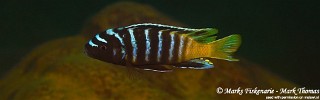
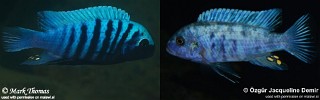
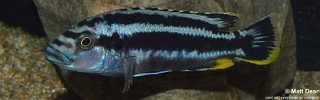
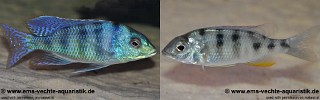
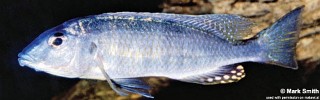
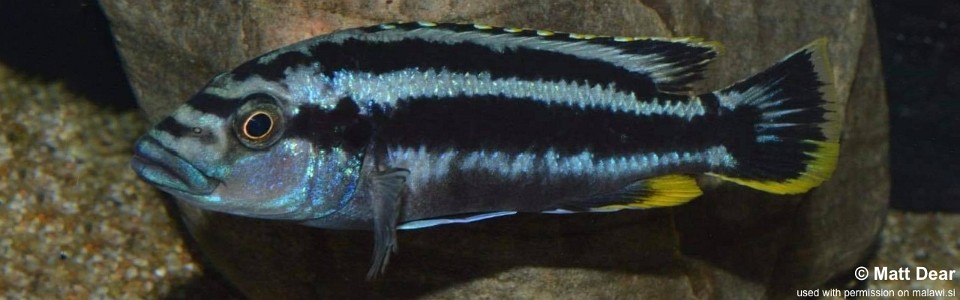



Photo gallery