Sandy habitats, rarely intermediate habitats.
Breeding males may occupy territories near rocks but are also seen over open sand.
Usually found in shallow water together with large sand-dwelling cichlids.
Geographic distribution:
Occurs throughout Lake Malawi.
Typical adult size:
Males reach about 20 cm total length.
Females remain approximately one fifth smaller.
Sexual dimorphism:
Dominant males are blue with dark unpaired fins and often display vertical bars on the anterior flanks.
Females are silvery; dominant females may darken and show vertical bars but do not become blue.
Aquarium setup:
It is recommended to keep only one male per aquarium and to avoid combining with species that closely resemble the male breeding coloration.
Diet:
Opportunistic feeder attracted to disturbed sediment.
Feeds on small arthropods and cladocerans measuring about 0.3–0.8 mm, often filtering debris clouds produced by larger sand-sifting cichlids.
Breeding:
Spawning may occur on small platforms near rocks, though many individuals are non-territorial.
Eggs are fertilized outside the female’s mouth.
Mouthbrooding females remain on open sand and guard the offspring there.
Aggression:
Males are frequently territorial in aquarium conditions and show increased aggression toward similar-looking males.
Special notes:
Characterized by unicuspid buccal teeth and a high occipital crest.
Large specimens may develop a head hump, though less pronounced than in Cyrtocara moorii.
Known locally as “Kabibi”.

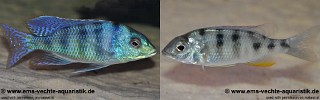
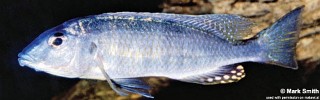
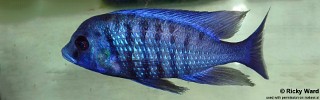
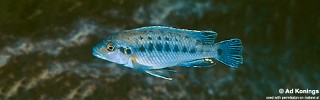
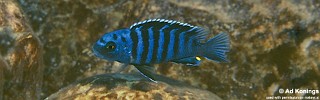
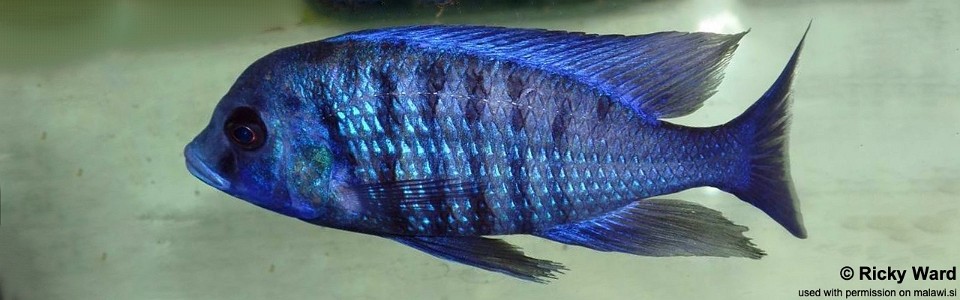



Photo gallery