Inhabits sediment-rich intermediate habitat, most often at rock–sand interfaces and in areas
where sand patches are interspersed among rocks.
Geographic distribution:
Reported from Masasa Reef to Otter Point.
Typical adult size:
Around 10–11 cm total length in males in imports, becoming larger in aquarium.
Sexual dimorphism:
Males are larger and show intense sky-blue coloration with blue-black bars and longer fins
with broader anal ocelli; females are blue-grey.
Recommended aquarium size:
An aquarium volume of 300 L with a minimum tank length of 120 cm is recommended.
Aquarium setup:
Provide ample rock structures and shelters, while also maintaining open sandy areas without
rocks. A harem ratio of one male to at least 5–6 females is recommended to diffuse
aggression. In community tanks, robust mbuna from genera such as Metriaclima,
Pseudotropheus, Melanochromis and Cynotilapia are suggested as
tank-mates to help distribute intraspecific aggression.
Diet:
Primarily algivorous; feeds on aufwuchs by firmly grasping attached algae with closely
set teeth and shaking to detach it from the substrate, and also consumes plankton.
Breeding:
Maternal mouthbrooder. Males excavate a pit beneath a stone and defend the spawning
territory for several hours, while the spawning itself is brief; after spawning, the male
maintains only a loose interest in the site. Females incubate eggs and fry for about
three weeks, then release fry within about one week.
Aggression:
Highly aggressive within the species; toward other species aggression is mainly linked to
territorial disputes and is most pronounced during spawning periods.
Special notes:
Recognizable by exceptionally broad vertical bars and an unusually vivid sky-blue male
coloration within the genus. The species combines a short, high-backed body, steep
angular head profile and narrow mouth, placing it among the most specialized
Tropheops. It occupies a wide depth range and may track the rock–sand interface
from very shallow water to at least 40 m, and it has been recorded colonizing an
artificial reef at 3–5 m depth. Males show strong daily territorial activity, with
morning defense followed by periods in which multiple males may feed in proximity.
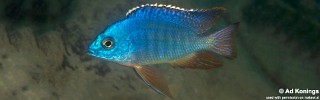
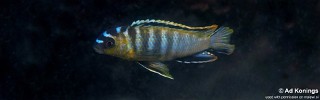
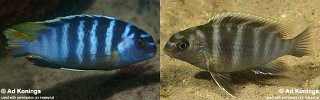
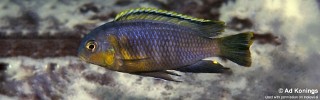
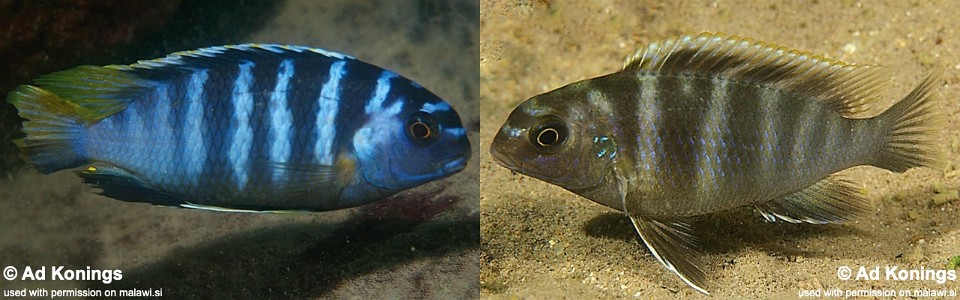




Photo gallery