Sandy habitats, with deeper sandy bottoms described as the usual foraging area; mouthbrooding
females are often encountered in shallow intermediate habitat.
Geographic distribution:
Observed along the eastern shores of the lake, between central Mozambique and Luwala Reef in
Malawi, including breeding leks reported from Lumessi (Mozambique) and Liwani, just south of the
Nsinje River on the Malawi east coast.
Typical adult size:
Males reach about 25 cm total length, while females reach about 20 cm total length.
Sexual dimorphism:
Males grow larger than females.
Recommended aquarium size:
An aquarium volume of at least 900 L and a minimum tank length of
250 cm are recommended.
Aquarium setup:
Provide extensive open areas of fine sand for foraging and bower construction, with
only a few larger rock plateaus or scattered large stones. Planting is best avoided as
adults dig persistently.
Diet:
A sand-sifting feeder that takes insect larvae from the substrate; sand is filtered through the
gills while edible material is retained.
Breeding:
Lek-breeding maternal mouthbrooder. At Lumessi (Mozambique) males built bowers at about
35 m depth with diameters of at least 3 m, sometimes with neighboring bowers less than
1 m apart. A second lek was reported at Liwani in very shallow water, not much deeper than
5 m. Mouthbrooding females are frequently seen in shallow water.
Aggression:
In aquaria, males are described as highly territorial for extended periods and respond more
aggressively toward lookalike males; keeping a single male is recommended.
Special notes:
An elongate, robust sand-sifter with a dark diagonal stripe from nape to caudal base and yellow
on the snout, lower body, anal fin, and lower caudal lobe; non-breeding individuals are readily
recognized by this pattern. Material attributed to this species has been described with a distinct
diagonal band, while another treatment applies the name to a form lacking such a band.
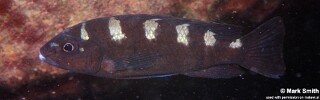
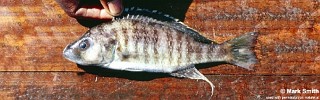
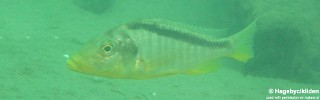
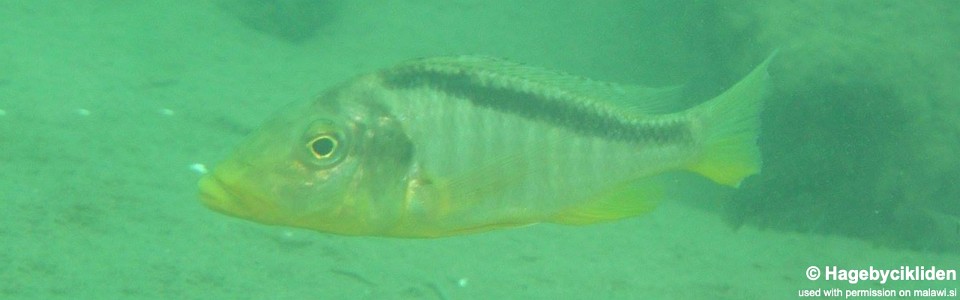




Photo gallery