Rocky habitat, sometimes extending into intermediate zones.
Territorial males are most common at about 5–10 m depth, while females and juveniles often forage in very shallow rocky areas.
Geographic distribution:
Described from Chinyankwazi and Chinyamwezi islands in the southeastern arm of Lake Malawi, but occurring more widely along rocky shores and reefs north of these islands.
Individuals matching the island populations are reported between Chimwalani (Eccles) Reef (Malawi) and just south of the Chiloelo River (Mozambique), with further occurrence northwards towards Metangula where male coloration varies and females are mostly silvery-gray.
Typical adult size:
Males reach about 16 cm total length in the wild and are stated to grow larger in aquaria, likely to about 20 cm.
Females remain about 15% smaller than males.
Sexual dimorphism:
Males and females differ strongly in coloration and breeding behavior.
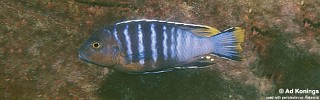
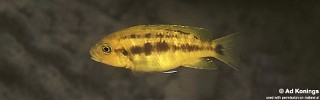
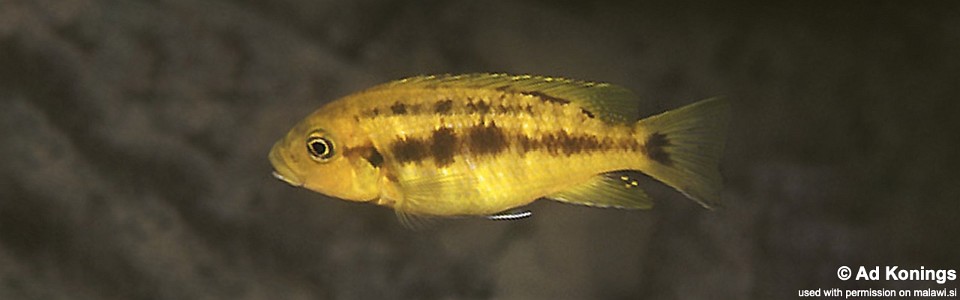
In populations south of the Chiloelo River, males are blue to blue-black with 7–9 dark bars, while adult females are yellow to golden with a melanin pattern of two horizontal rows of spots and usually 7–9 vague vertical bars; mouthbrooding females may appear dirty yellow-gray.
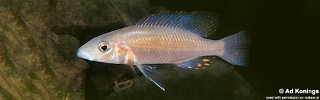
In populations north of the Chiloelo River, males may show a yellow belly and yellow dorsal fin, while females are described as more silvery-gray.
Recommended aquarium size:
A minimum aquarium length of about 200 cm is stated as possible, with a larger aquarium recommended.
Aquarium setup:
Provide rockwork with caves and sufficient shelter for female(s), including caves too small for the male to enter.
Keep only one male, as males are described as likely to be permanently territorial in the aquarium.
When a female is mouthbrooding, it is advised to separate her from the male (e.g., by moving her to a nursery tank or removing the male until fry are released).
Diet:
Feeds by combing loose aufwuchs from rocks; in the wild, non-territorial individuals and females may also take substantial plankton, especially at Chinyamwezi and Chinyankwazi.
In the aquarium, algae-based foods such as spirulina flakes or sticks are recommended, and soft, easily digestible high-protein foods (e.g., mosquito larvae, worms, adult brine shrimp) are cautioned against due to long-term digestive problems.
Breeding:
Males defend relatively large territories (stated as approximately 4 m in diameter) centered on a spawning site, usually a small cave among rocks.
Spawning takes place inside the male’s cave; females may visit several males for fertilization.
Females are mouthbrooders, with incubation stated as about three weeks, after which fry are released and immediately abandoned; in southern populations the fry are described as bright yellow and are released at the same depth as the adults.
Aggression:
Males are described as strongly territorial and are recommended to be kept as a single male per aquarium; males may respond aggressively to look-alike tankmates.
Special notes:
This species is placed in the Petrotilapia nigra group and is described as barely distinguishable from Petrotilapia nigra, with separation relying largely on coloration and geographic interpretation rather than clear morphological differences.
It was formerly known in the aquarium trade as Petrotilapia sp. “gold”; collection from Chinyankwazi and Chinyamwezi ended after these islands became protected under Lake Malawi National Park regulations (1986).
A definitive test of separation from P. nigra is described as lacking, with mate-choice experiments noted as an important but unperformed approach for evaluating species boundaries.





Territorial males are most common at about 5–10 m depth, while females and juveniles often forage in very shallow rocky areas.
Individuals matching the island populations are reported between Chimwalani (Eccles) Reef (Malawi) and just south of the Chiloelo River (Mozambique), with further occurrence northwards towards Metangula where male coloration varies and females are mostly silvery-gray.
Females remain about 15% smaller than males.
In populations south of the Chiloelo River, males are blue to blue-black with 7–9 dark bars, while adult females are yellow to golden with a melanin pattern of two horizontal rows of spots and usually 7–9 vague vertical bars; mouthbrooding females may appear dirty yellow-gray.
In populations north of the Chiloelo River, males may show a yellow belly and yellow dorsal fin, while females are described as more silvery-gray.
Keep only one male, as males are described as likely to be permanently territorial in the aquarium.
When a female is mouthbrooding, it is advised to separate her from the male (e.g., by moving her to a nursery tank or removing the male until fry are released).
In the aquarium, algae-based foods such as spirulina flakes or sticks are recommended, and soft, easily digestible high-protein foods (e.g., mosquito larvae, worms, adult brine shrimp) are cautioned against due to long-term digestive problems.
Spawning takes place inside the male’s cave; females may visit several males for fertilization.
Females are mouthbrooders, with incubation stated as about three weeks, after which fry are released and immediately abandoned; in southern populations the fry are described as bright yellow and are released at the same depth as the adults.
It was formerly known in the aquarium trade as Petrotilapia sp. “gold”; collection from Chinyankwazi and Chinyamwezi ended after these islands became protected under Lake Malawi National Park regulations (1986).
A definitive test of separation from P. nigra is described as lacking, with mate-choice experiments noted as an important but unperformed approach for evaluating species boundaries.
Photo gallery