Sediment-free rocky habitat. It is most frequently encountered in purely rocky areas but is
sometimes seen in intermediate zones as well.
Geographic distribution:
Very widely distributed. Along the eastern shore it occurs as far north as Liuli, Tanzania.
Along the western shore it is not found farther north than the Mbenji islands. The southernmost
populations occur just south of Monkey Bay, but not at Nkhudzi or farther south.
Typical adult size:
Attains a total length of about 14–15 cm.
Recommended aquarium size:
An aquarium volume of 500 L is recommended.
Diet:
Omnivorous with a strongly predatory component. Predominantly hunts cichlid fry and is also
observed feeding from the aufwuchs and from plankton. It may also take crustaceans, insect larvae,
and nymphs, and is attracted to stirred-up sediment.
Breeding:
Territorial males are rare and mainly occur where population density is high and sexually active
males are close together, such as at Maleri and Mbenji islands. Mouthbrooding females hide among
the rocks and are rarely encountered.
Aggression:
Aggressive within the species, particularly among males, while generally tolerant toward other
species. Adults are usually solitary, though subadults may form small groups.
Special notes:
A predatory, non-specialized Melanochromis whose dark coloration blends with caves and
rocky recesses where it hunts. It lacks the bright all-blue male coloration seen in some related
species. Females along the Mozambique shore are often lighter with two distinct black stripes,
whereas females at other localities may be very dark with the stripes nearly invisible. The
species has previously been confused with the closely related M. chipokae, which is
restricted to Chidunga Rocks.
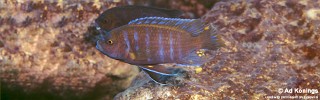
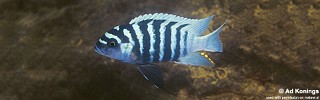
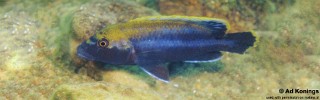
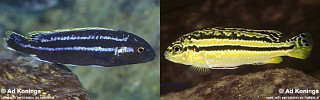
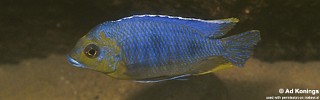
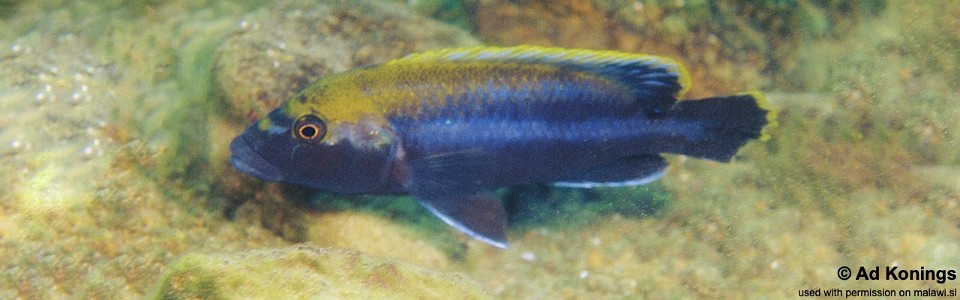




Photo gallery