Shallow rocky habitat of turbulent, sediment-free shores with medium to large
rocks, boulders and slabs; rare in intermediate areas.
Geographic distribution:
Eastern coast of Lake Malawi from Manda to Kirondo and western coast from
Kande Island to Mdoka.
Typical adult size:
Imported specimens reach up to 11 cm TL and may grow larger in aquarium
conditions.
Sexual dimorphism:
Males are larger than females, with longer fins and larger anal ocelli. Males show
a greenish to rusty yellow coloration and may have dark ventral fins in eastern
populations. Females have a silvery-gray to cream-white ground color with a
characteristic pattern of black vertical and horizontal markings.
Recommended aquarium size:
An aquarium volume of 300 L with a minimum tank length of 120 cm is recommended.
A minimum tank length of around 2 m is necessary to maintain more than one active male in the same aquarium.
Aquarium setup:
Requires abundant rock structures (rocks, flat stones or similar shelters)
distributed over large sandy patches to allow territory formation.
Diet:
Feeds primarily from upper and vertical rock surfaces, cropping filamentous
algae from the biocover using characteristic jerking movements. Plankton may
also be taken. In aquarium, a diet rich in vegetable matter is required.
Breeding:
Maternal mouth-brooder. Males excavate a pit beneath a stone by removing sand.
Courtship involves displaying and quivering movements before leading the
female to the spawning site. Spawning takes several hours, while egg deposition
lasts less than one hour. Incubation lasts about 3 weeks.
Aggression:
Extremely aggressive and strongly territorial, defending algal gardens and rock
surfaces against conspecifics and other species. Females are non-territorial and
often occur in small groups.
Special notes:
Distinguished by a slender body, receding forehead and a strongly checkered
melanin pattern with nearly equally marked vertical and horizontal stripes.
Males defend conspicuous algal gardens, visible as yellow-green patches on
rocks, a behavior considered unusual within the genus.
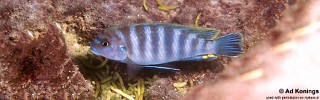
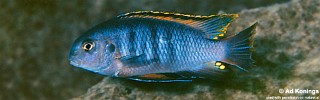
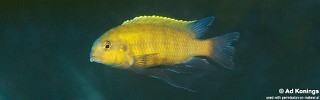
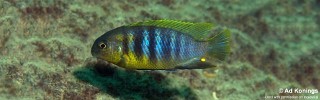
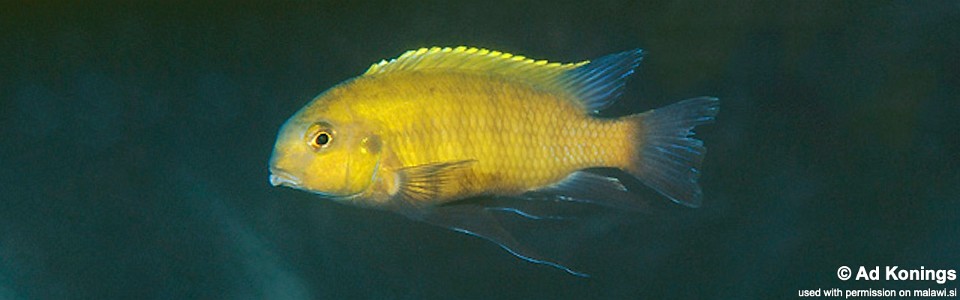




Photo gallery