Upper rocky habitat free from sediment, often consisting of very large boulders.
The species prefers vertical rock faces in very shallow water with considerable wave action
and is rarely observed deeper than 5 m.
Geographic distribution:
Mumbo Island, Thumbi West Island, and Mbenji Island.
Typical adult size:
Males up to about 17 cm total length; females rarely exceed about 14 cm
total length.
Sexual dimorphism:
Males are bright blue on head, body, and fins with a distinct black submarginal
band in the dorsal and anal fins. Females are light brown to gray-brown and also possess
a conspicuous black submarginal band in the dorsal and anal fins.
Recommended aquarium size:
Minimum aquarium length about 200 cm.
Aquarium setup:
Rock-dominated setup with numerous caves and shelters among large stones.
Only one male per aquarium is recommended due to strong territoriality.
Provide secure retreats for females that are inaccessible to the male.
Diet:
Specialized Aufwuchs feeder harvesting diatoms and small algae from rocks.
The large lips and multiple rows of tricuspid teeth are used to rake algae and
sediment from the substrate, leaving characteristic cleaned patches.
Breeding:
Maternal mouthbrooder. Males defend territories approximately 5 m in diameter,
centered around a cave with a top entrance among rocks. Spawning occurs inside the cave.
Females incubate eggs and larvae in the mouth for about three weeks, remaining solitary
and hidden among rocks. Fry are released and immediately independent, feeding on Aufwuchs.
Aggression:
Males are strongly territorial, especially during breeding, and maintain
large defended areas in the rocky habitat.
Special notes:
Distinguished by a dark submarginal band in the spinous portion of the dorsal
fin in both sexes. Closely associated with rocky
substrates and unlikely to be significantly affected by seine fisheries, though it may
be caught in gill nets set near rocks.
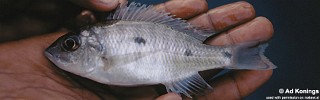
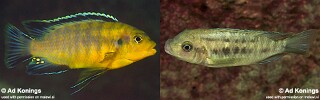
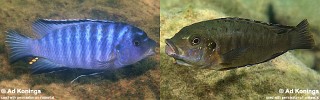
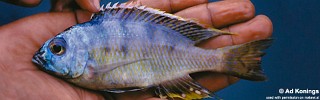
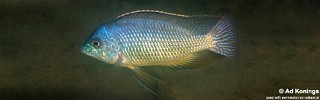
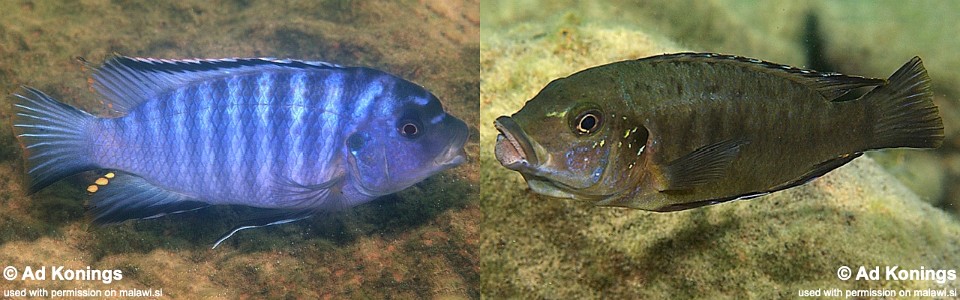




Photo gallery