Shallow sediment-free rocky habitat; also recorded in deeper sediment-free rocky zones
down to at least 25 m.
Geographic distribution:
Southern Lake Malawi, including Chidunga Rocks, Maleri Islands,
Mumbo Island, Thumbi West Island, Nakantenga Island and Nankoma Island.
Typical adult size:
About 10–11 cm total length in imported specimens; reported to grow larger in aquarium.
Sexual dimorphism:
Males show a lilac silvery-blue ground coloration with an ochre-yellow anterior body,
longer fins and larger anal ocelli. Females are grey to greyish with less intense coloration.
Recommended aquarium size:
An aquarium volume of around 400 l or more is recommended.
Aquarium setup:
Provide numerous rocky shelters (rocks, flat stones or similar structures) interspersed
with sandy areas to allow territory formation.
Diet:
Feeds primarily on filamentous algae plucked from rocks and may also consume plankton.
In captivity, a predominantly vegetable-based diet is advised.
Breeding:
Maternal mouthbrooder. Males excavate a pit beneath a stone and court females by
displaying and quivering before leading them to spawn in the pit. Incubation is
reported to last about 3 weeks.
Aggression:
Males are territorial and can be aggressive, especially toward conspecifics,
though described as not among the most aggressive members of the genus.
Special notes:
Characterized as a high-bodied Tropheops with a domed forehead. Species limits within
the “lilac” complex are considered unclear, and some populations previously treated
as separate forms have been suggested to represent the same taxon.
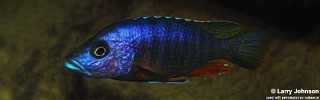
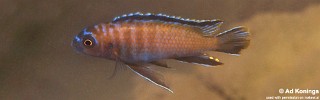
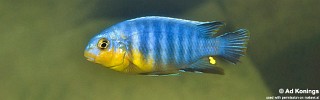
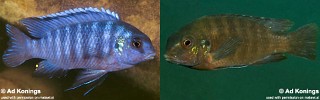
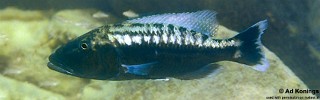
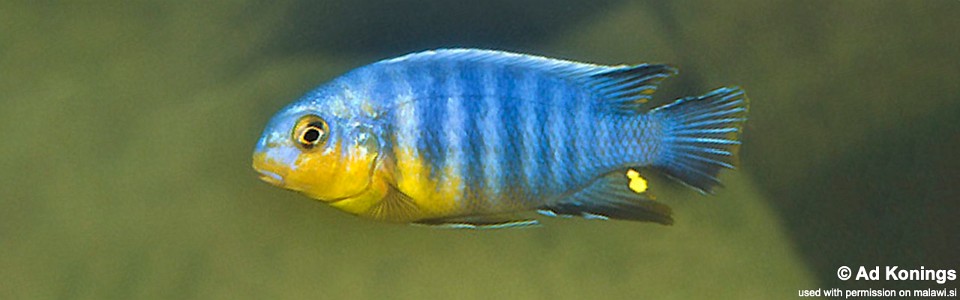




Photo gallery