Pseudotropheus sp. 'williamsi maleri' Namalenje Island
Genus:
Pseudotropheus
Biotope:
Upper rocky habitat of Lake Malawi, particularly in areas with large
rocks. Like other members of the Pseudotropheus williamsi group,
it is associated with rocky zones where rocks may break the surface.
Geographic distribution:
Occurs around the Maleri Islands and at Nankoma and Nakantenga
islands in Lake Malawi.
Typical adult size:
Up to about 15 cm total length for members of this super-species.
Sexual dimorphism:
Males are more colorful, with longer fins and larger ocelli. Females
usually remain greyish brown.
Recommended aquarium size:
A tank volume preferably over 400 l is recommended. To maintain
more than one active male, a minimum tank length of around
2 m is required.
Aquarium setup:
A spacious aquarium with extensive rockwork and numerous shelters
of various sizes is required to provide territorial structure and
refuge.
Diet:
Opportunistic feeder relying mainly on insects and their larvae.
Diet items include zooplankton, detritus and Aufwuchs. Insects
are taken at the surface and sometimes above it, with individuals
jumping out of the water to capture prey.
Breeding:
Maternal mouthbrooder. Spawning takes place in the male’s territory
with circular movements and a T-shaped posture. Eggs are taken
into the female’s mouth and fertilized there.
Aggression:
Large and strongly territorial mbuna. Can be highly aggressive
toward conspecifics and intrusive toward less active mbuna in
community aquaria.
Special notes:
An undescribed member of the Pseudotropheus williamsi
super-species, characterized by orange-red patches on the head
and dorsal fin. It is closely related to other southern forms
such as Pseudotropheus brevis and Pseudotropheus sp.
‘williamsi makanjila’, and has previously been associated with
Pseudotropheus galanos due to similarities in coloration.
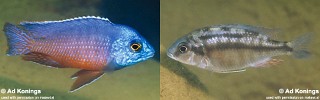
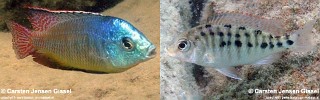
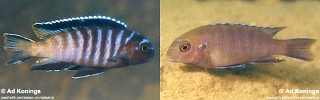
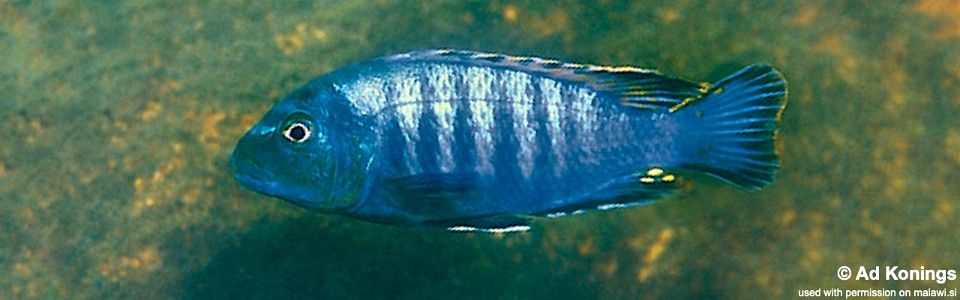




Photo gallery