Primarily sediment-rich rocky habitat.
In the absence of P. taeniolatus also occurs in the upper,
sediment-free rocky habitat.
On the northwestern coast often found at somewhat deeper levels;
on the eastern coast mainly in shallow rocky areas.
Geographic distribution:
Northern half of Lake Malawi on both shores and along
most of the eastern coastline north of Makanjila Point.
Typical adult size:
Males up to about 16 cm total length.
Females usually about one third smaller.
Sexual dimorphism:
Adult males show yellow breast and belly,
often extending onto the shoulder and flank.
Females and juveniles silvery with vertical and horizontal
melanin elements; mid-lateral stripe typically broken into
irregular blotches.
Recommended aquarium size:
A minimum aquarium volume of 300 l and a tank length
of at least 130 cm are required for one dominant male with
several females. Significantly larger aquaria are necessary if
more than one adult male is to be maintained.
Aquarium setup:
Provide rocky structures with flat surfaces for territories.
Avoid tankmates that resemble the male breeding coloration to
reduce aggression.
Diet:
Predominantly herbivorous.
Sucks algae from small pockets in rocks by sealing the lips
against the substrate and creating suction.
May also ingest insect larvae.
Feeds on plankton when available.
Breeding:
Males defend territories on top of large or medium-sized rocks,
sometimes marked with a thin layer of fine sand.
Spawning occurs on the rock surface.
Eggs are fertilized in the female’s mouth.
Females mouthbrood for about three weeks and continue guarding
fry for approximately another month after first release.
Aggression:
Strongly territorial males.
In sympatry often dominant over P. taeniolatus
and may compete for breeding sites.
Special notes:
Closely related to other Steveni-type species,
especially P. taeniolatus and
P. sp. ‘steveni taiwan’.
Distinguished from P. fenestratus by yellow to red
ventral fins in males and less pronounced vertical barring.
Taxonomic relationships within the Steveni group require
further study.
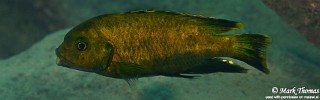
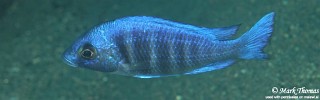
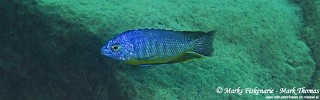
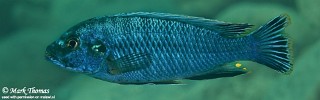
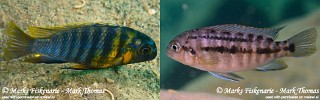
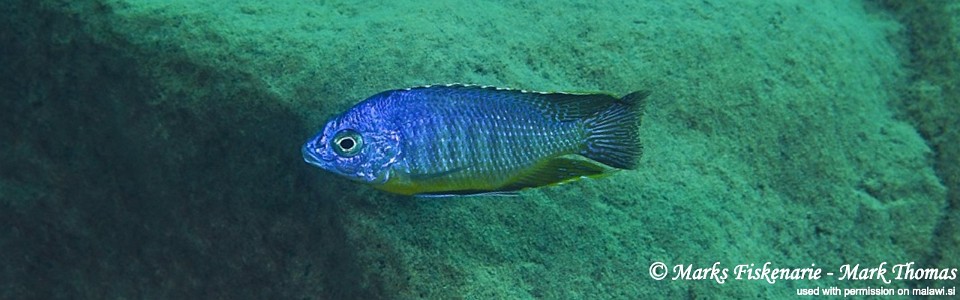




Photo gallery