Intermediate habitat associated with rocky areas, similar to other
members of the Pseudotropheus williamsi group found in the
upper rocky zone of Lake Malawi.
Geographic distribution:
Reported mainly from Makonde and Manda in Tanzania and from
Nkhata Bay on the central western coast of Lake Malawi.
Typical adult size:
Up to 17 cm in males and 15 cm in females.
Sexual dimorphism:
Males are more colorful and develop longer fins and larger ocelli,
whereas females are less intensely colored.
Recommended aquarium size:
An aquarium volume of 500 L is recommended.
Aquarium setup:
A large aquarium with extensive rockwork and numerous shelters
is required.
Diet:
Omnivorous. Opportunistic feeding includes insects and their
larvae, zooplankton, detritus and Aufwuchs. Insects are taken
at the surface and sometimes above it, with individuals
jumping out of the water to capture prey.
Breeding:
Maternal mouthbrooder. Spawning occurs in the male’s territory
with circular movements and a T-shaped posture. Eggs are
collected in the female’s mouth and fertilized there.
Aggression:
Aggressive within the species. Toward other species aggression
is mainly observed during spawning periods.
Special notes:
Characterized by predominantly ochre-yellow coloration. Northern
Tanzanian populations are mainly ochre-yellow with slight blue
on the lips, while central Tanzanian populations are mainly
blue with yellow patches. Blue lips are retained in males from
Nkhata Bay.
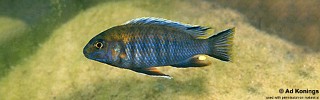
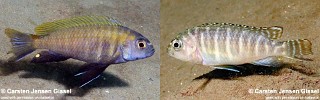
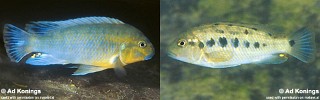
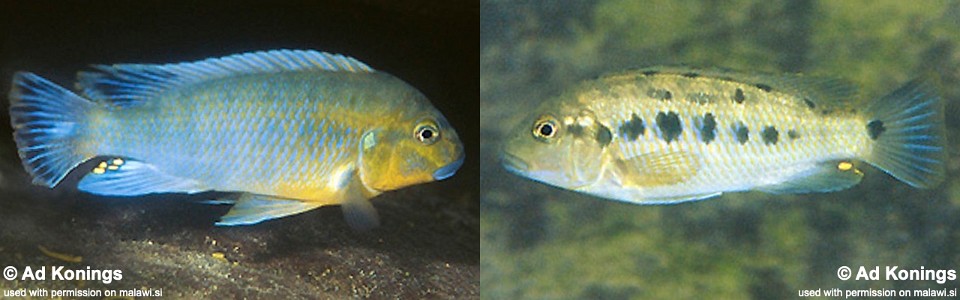




Photo gallery