Shallow intermediate habitat, most commonly at depths
around three meters but occasionally recorded deeper
than 20 meters.
Geographic distribution:
Restricted to the southeastern arm of Lake Malawi,
recorded from Nkhudzi, Mphandi and Boadzulu islands,
and Makokola Reef.
Typical adult size:
Males attain about 10 cm total length in the wild;
females remain approximately one fifth smaller.
Sexual dimorphism:
Breeding males exhibit the reversed melanin pattern
typical for the genus, with a yellow-brown to dark
brown ground colour. Females retain the basic
horizontal stripe pattern.
Diet:
Opportunistic feeder attracted to stirred-up material.
Picks at moving items in the shallow habitat and also
feeds on algae attached to rocks.
Breeding:
Males in breeding coloration are seen within small
foraging groups but do not defend territories.
Aggression occurs when breeding males encounter each
other, yet no fixed spawning site is protected.
Females are maternal mouthbrooders; mouthbrooding
females have not been observed in the wild.
Special notes:
Previously confused with M. heterochromis in the
literature. The species can be distinguished by a
larger interorbital width and a deeper head compared
with M. melanopterus, and by diagnostic
differences in lower jaw and premaxillary pedicel
proportions relative to M. heterochromis.
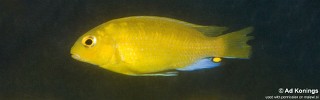
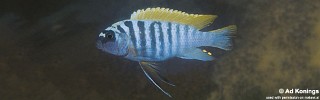
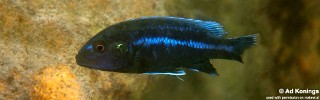
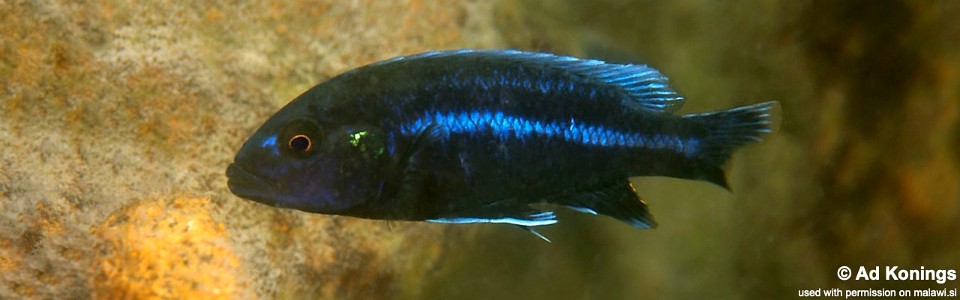




Photo gallery