Intermediate sand–rock interface habitat. Very common on small rocks of the
intermediate zone, where it feeds from the biocover.
Geographic distribution:
Occurs along the Mozambican coast between Chuanga and Nkhungu Reef.
Typical adult size:
Males attain a maximum total length of about 11 cm; females remain approximately
one fifth smaller.
Recommended aquarium size:
An aquarium volume of 400 L is recommended.
Diet:
Omnivorous. Feeds mainly on algae from the aufwuchs but also consumes
invertebrates and other available food items. Most of the time it nibbles
from the biocover and is attracted to stirred-up debris. Foraging groups
are commonly encountered.
Breeding:
Males in breeding coloration are usually solitary and rarely join foraging
groups. Territoriality is uncommon, but quarrels between breeding males
occur and mainly consist of chasing rivals from feeding sites. Spawning
takes place at suitable sites within the rocky habitat. Mouthbrooding
females hide among rocks and remain solitary.
Aggression:
Intraspecific aggression occurs mainly among breeding males, particularly
at feeding sites, but sustained territorial behaviour is rare.
Special notes:
Distinguished from M. auratus by the presence of black spots in the
lower lobe of the female caudal fin and by the absence of a narrow yellow
mid-lateral stripe in males. Within its distribution it is the only member
of the closely related M. auratus group occupying the rocky biotope
and shows no marked specialization in feeding or habitat use. Populations
at Metangula and N’kolongwe exhibit slightly longer snouts and shallower
bodies; males in the southern range are blue-black with light-blue stripes,
while those farther north are brown-blue with light brown stripes.
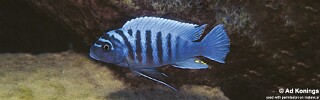
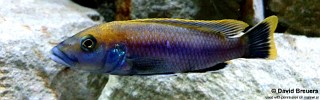
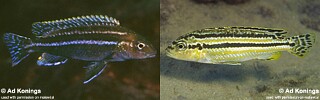
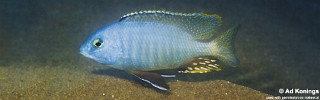
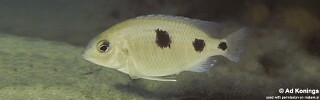
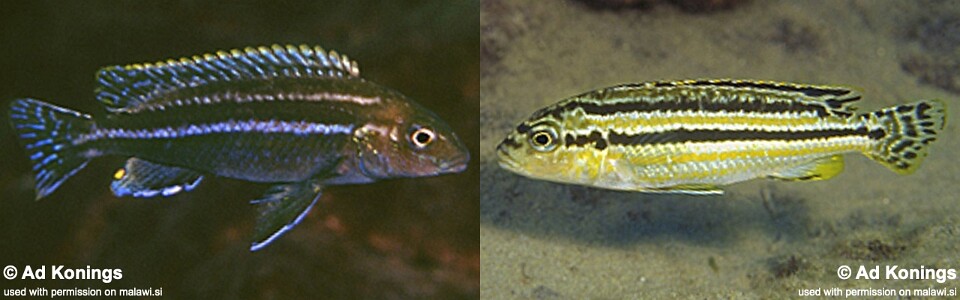




Photo gallery