Lake Malawi (erroneously labelled as Lake Tanganyika in the original species description)
Biotope:
Vegetated and intermediate habitats,
especially the deeper parts of plant beds,
but also venturing over adjacent sand or rocks.
Geographic distribution:
Lake-wide distribution in Lake Malawi.
Typical adult size:
Males reach about 14 cm total length;
females up to about 10 cm.
Sexual dimorphism:
Males develop breeding coloration and defend territories.
Females and non-territorial males show distinct red lappets
along the dorsal fin margin.
Recommended aquarium size:
A spacious aquarium is recommended with only one adult male per tank
due to strong territorial behavior.
Aquarium setup:
Maintain pH 7.0–8.5 and temperature 23–28 °C.
Provide sandy substrate with some rocks and vegetated areas
to allow natural feeding and spawning behavior.
Diet:
Feeds by blowing into sediment on sand and around plant bases,
extracting insect larvae and soft-bodied crustaceans from mud and debris.
Breeding:
Territorial males construct shallow, saucer-shaped spawning platforms
in shallow water, often against a rock or object.
Sites are built in small colonies.
Females are courted when entering a territory.
Mouthbrooding females incubate the eggs after spawning.
Aggression:
Males are highly territorial during breeding
and defend their spawning sites vigorously.
Special notes:
Distinguished by a thin but distinct red edge in the dorsal fin
and an often straight mid-lateral stripe.
Differs from Protomelas triaenodon by having bicuspid
rather than tricuspid outer teeth.
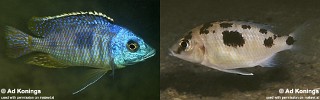
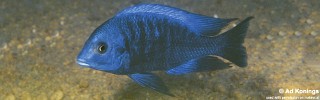
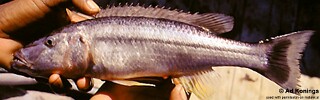
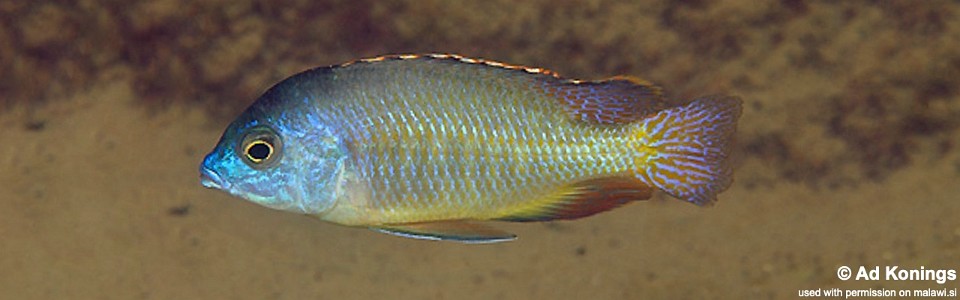




Photo gallery