Sandy environment at depths of 12–25 m; also associated with
submerged tree branches and trunks covered with aufwuchs.
Geographic distribution:
Western shore south of Nkhata Bay, recorded at Msuli, Dwanga and
Senga Bay; on the eastern shore at Luwala and Chimwalani (Eccles) Reef.
Typical adult size:
Males up to about 14 cm total length and females up to
about 12 cm.
Recommended aquarium size:
An aquarium volume of 300 l is recommended.
Aquarium setup:
Provide abundant rockwork arranged to create numerous passages
and hiding places.
Diet:
Herbivorous aufwuchs grazer. Feeds on algae growing on submerged
wood in shallow areas and may also consume plankton and small
invertebrates from sandy substrates.
Breeding:
Breeds throughout the year in captivity. In the aquarium males
excavate spawning pits between rocks and defend territories; in the
lake, breeding males are not territorial and do not construct pits.
Aggression:
Relatively peaceful within the species and toward other species;
multiple males can be kept together.
Special notes:
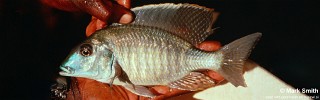
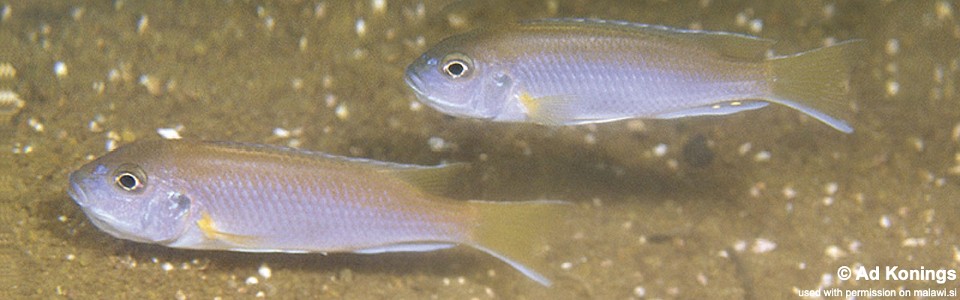
Closely related to Pseudotropheus elegans. Differs from
that species by lacking black submarginal bands in the pelvic and anal
fins and in the lower lobe of the caudal fin. Shows bright yellow fins
with a bluish body and has bicuspid teeth.
Northern populations from Ngara, Karonga and Itungi, previously included
in P.sp. ‘acei’ and known in the hobby as
“White-Tail Acei”, are currently are currently regarded as variants of P.elegans
(on our website these northern populations are listed as P.cf.elegans
to reflect their distinction from typical P.elegans).
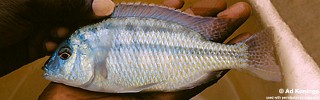
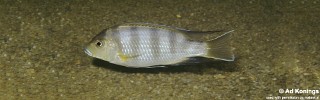
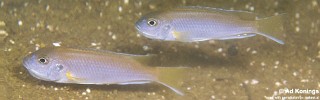
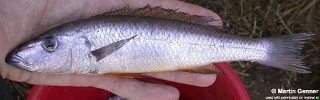




Northern populations from Ngara, Karonga and Itungi, previously included in P. sp. ‘acei’ and known in the hobby as “White-Tail Acei”, are currently are currently regarded as variants of P. elegans (on our website these northern populations are listed as P. cf. elegans to reflect their distinction from typical P. elegans).
Photo gallery