Pure rocky habitat dominated by huge boulders, with
territorial males typically occurring at depths greater than
15 m in strong-current areas around reefs.
Geographic distribution:
Restricted to Taiwanee Reef (north of Chizumulu Island), Higga Reef, and
Ngkuyo (Mbamba Bay) Island.
Typical adult size:
Males reach about 17 cm total length; females reach
about 13 cm total length.
Sexual dimorphism:
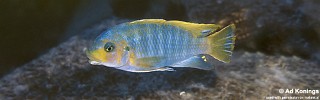
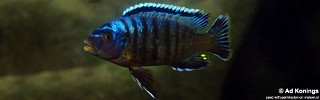
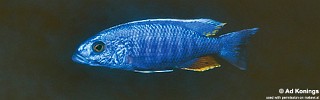
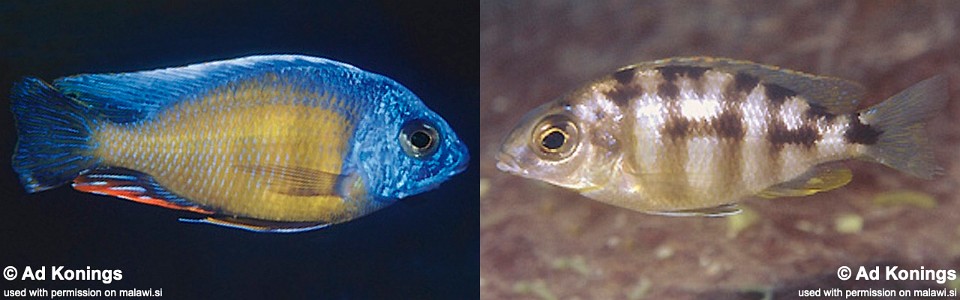
Males differ in coloration from similar “Steveni” forms,
including a white to light-blue dorsal fin and a wide yellow to
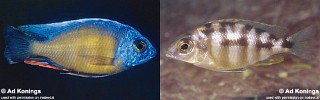
red margin on the anal fin. Females typically show a clear to
yellowish anal fin and may show horizontal elements in the basic
melanin pattern.
Recommended aquarium size:
A minimum aquarium volume of 300 l and a tank length
of at least 130 cm are required for one dominant male with
several females. Significantly larger aquaria are necessary if
more than one adult male is to be maintained.
Aquarium setup:
Provide rocky structures with flat surfaces for territories.
Avoid tankmates that resemble the male breeding coloration to
reduce aggression.
Diet:
Feeds primarily on algae from rocks by biting into the
algal mat and sucking out loose material, including unattached
algal strands and diatoms.
Breeding:
Territorial males defend a large section on the upper side
of a large boulder; the spawning site within the territory often
has lush algal growth due to exclusion of other herbivores.
Mouthbrooding females are typically solitary and do not form
nursery schools.
Aggression:
Males defend territories on boulders and exclude other
herbivores from key areas; adult males are strongly territorial
in captivity.
Special notes:
Undescribed species; the provisional name reflects its close relationship
with other “Steveni” forms among aquarists. The name “Taiwan” refers to
Taiwanee Reef (formerly Taiwan Reef), where the first population was
discovered. In its distribution area it is the only Steveni present.
Reported to be vulnerable to intensive ornamental fish collecting; populations
at Taiwanee and Higga reefs have declined markedly due to over-collecting.




Reported to be vulnerable to intensive ornamental fish collecting; populations at Taiwanee and Higga reefs have declined markedly due to over-collecting.
Photo gallery