Inhabits intermediate habitats with patches of sand among rocks and sediment-covered
slabs, occurring to at least 25 m depth.
Geographic distribution:
Reported from Likoma Island and Thumbi West Island, and along the eastern coast
of the Nankumba Peninsula from Domwe Island to Nkhudzi, including several reefs.
Typical adult size:
Around 10 cm total length in imports, becoming larger in aquarium.
Sexual dimorphism:
Males are dark blue-grey with longer fins and larger anal ocelli; females are vivid
yellow. Both sexes display a conspicuous submarginal band on the dorsal and anal fins.
Recommended aquarium size:
An aquarium volume of around 300 L is recommended. To keep more than one active
male, a minimum tank length of about 150 cm is required.
Aquarium setup:
Provide abundant shelters formed by rocks and flat stones interspersed with sandy
areas. Avoid larger or highly aggressive congeners to reduce harassment and
hybridization.
Diet:
Feeds mainly on aufwuchs from rock and sand substrates and also consumes plankton;
in aquarium, a diet rich in vegetable matter is advised.
Breeding:
Maternal mouthbrooder. Males excavate shallow pits (3–5 cm deep and
14–26 cm in diameter) beneath or alongside rocks and defend these
territories during spawning. Females incubate eggs and fry in the mouth for
about three weeks.
Aggression:
Moderately aggressive for a member of Tropheops; territorial aggression
is directed mainly toward conspecifics, while females and juveniles are not
territorial.
Special notes:
Belongs to a group of shallow-bodied, weakly specialized Tropheops
inhabiting intermediate zones. Although the type locality is given as Likoma
Island, later accounts indicate that the original material likely originated
from Thumbi West Island, reflecting historical inaccuracies in locality data
for several Malawi cichlids described during the 1970s.
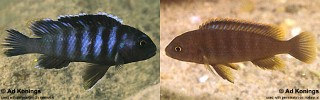
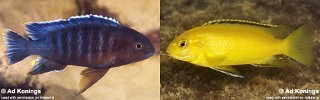
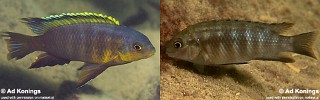
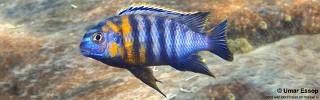
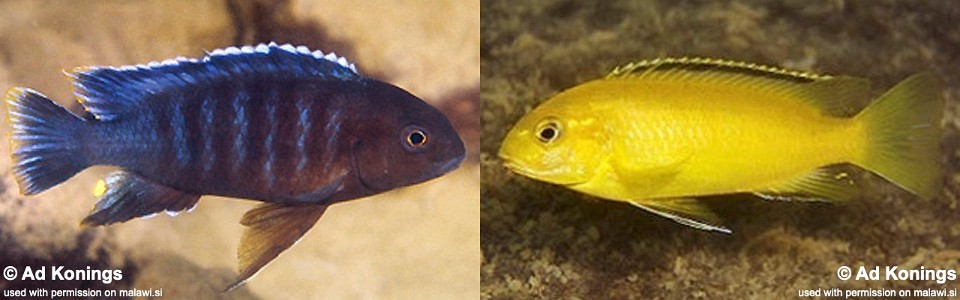




Photo gallery