Sediment-free rocky zones among medium to large rocks within about
3 m of the surface.
Geographic distribution:
Recorded from Monkey Bay, Nkhudzi and Boadzulu Island in Lake Malawi.
Typical adult size:
Around 14–15 cm total length.
Sexual dimorphism:
Males are more colourful, with longer fins and larger ocelli.
Females are usually greyish brown.
Recommended aquarium size:
A tank volume preferably over 400 l is recommended.
Aquarium setup:
Provide abundant shelters of various sizes using rocks and flat stones.
To keep more than one active male, a minimum tank length of around 2 m is
necessary to allow formation of more than one territory.
Diet:
An omnivorous, opportunistic feeder relying mainly on aufwuchs and
insect larvae, and also zooplankton. In captivity it accepts many
foods, but feeding should be controlled to limit fattening.
Breeding:
Maternal mouthbrooder. Spawning follows typical mbuna circular motions
with a T-shaped posture, after which the female incubates the brood
alone for about three weeks. Fry may be sheltered in the
female’s mouth for about one additional week before final release.
Aggression:
A large, aggressive mbuna that can become deadly towards conspecifics
and intrusive towards other species in the aquarium.
Special notes:
A member of the Pseudotropheus williamsi group, characterised
by orange-yellow patches on the head and a black submarginal band on
the dorsal fin. Formerly known as Pseudotropheus sp.
‘williamsi nkudzi’ and originally described in Melanochromis,
it has a history of frequent misidentifications in the aquarium trade.
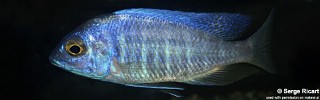
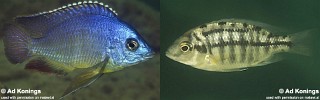
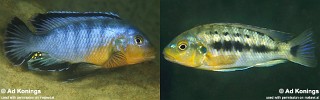
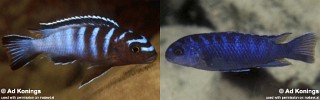
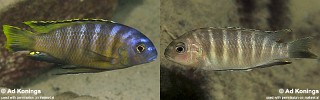
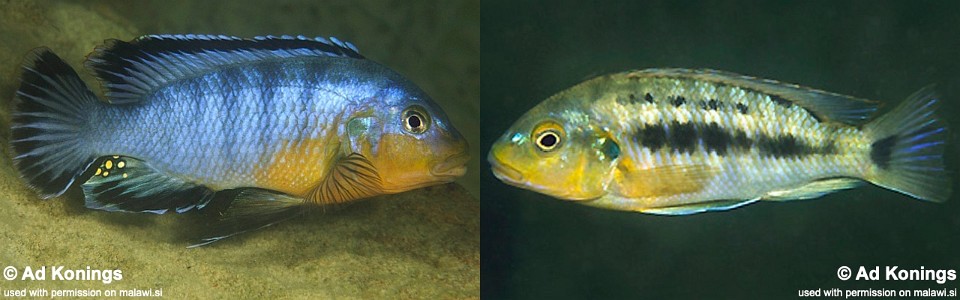




Photo gallery