Primarily associated with sandy areas and the
rock–sand interface. Frequently found near
submerged tree branches and trunks covered
with aufwuchs.
Geographic distribution:
Occurs in the northern part of Lake Malawi, including Chilumba Bay and Chitande Island.
Also recorded further south at Kasinda (Selewa). Ad Konings now regards the northern populations from
Ngara, Karonga and Itungi as variants of this species.
Typical adult size:
Males reach about 14 cm and females about
12 cm total length.
Sexual dimorphism:
Males are slightly larger and may develop a deeper
blue body coloration. Both sexes show a
grey-blue body with a yellowish dorsal fin.
A black submarginal band is present in the
pelvic and anal fins and in the lower lobe
of the caudal fin.
Recommended aquarium size:
An aquarium volume of at least 300 L is
recommended.
Aquarium setup:
Provide ample rockwork forming passages and
hiding places. Open sandy areas may also
be included. Due to its relatively peaceful
nature, several males can be maintained in
a suitably sized aquarium.
Diet:
Primarily herbivorous. Feeds on aufwuchs
growing on submerged wood and other
substrates, occasionally consuming
plankton and small invertebrates from
sandy areas.
Breeding:
Maternal mouth-brooder. In captivity males
may excavate pits between rocks and
defend small territories. Females
incubate eggs and fry in the mouth for
approximately 3 weeks.
Aggression:
Generally peaceful both within the species
and toward other mbuna. Considered one
of the calmer members of the genus.
Special notes:
Closely related to Pseudotropheus sp. ‘acei’. Distinguished from that species
by the presence of black submarginal bands in the pelvic and anal fins and
in the lower lobe of the caudal fin. The type locality is Chilumba Bay and
the species is common at Chitande Island just north of the bay, as well
as at Kasinda (Selewa). Northern populations from Ngara, Karonga and
Itungi, known in the hobby as “White-Tail Acei”, were previously
included in Pseudotropheus sp. ‘acei’ and are regarded by some authors as
variants of P. elegans. Based on our evaluation we consider these northern
populations to differ from typical P. elegans and, until their status is
clarified, we refer to them on our website as Pseudotropheus cf. elegans.
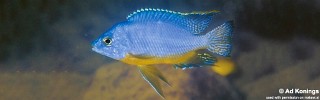
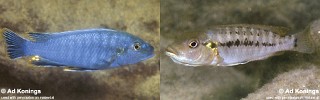
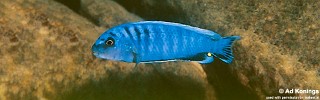
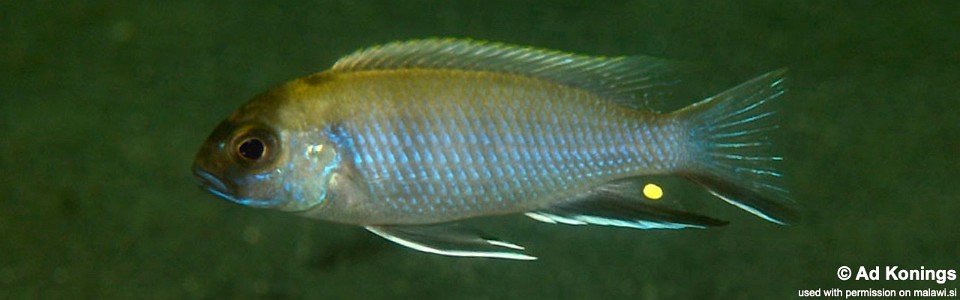




Photo gallery