Very shallow intermediate habitat where rocks are coated with fine sand and
aufwuchs.
Geographic distribution:
Along the northwestern shore of Lake Malawi, recorded from Nkhata Bay,
Lion's Cove, Ruarwe, Chitande Island, and Chewere.
Typical adult size:
Up to about 11–12 cm total length; a maximum of 135 mm total length has
been reported.
Sexual dimorphism:
Adult females are beige-gray with the melanin pattern, while adult males are
overall blue with reddish ventral fins.
Recommended aquarium size:
An aquarium with ample space is recommended, as males are reported to be very
aggressive toward tank mates.
Aquarium setup:
Provide ample hiding places and caves; it is advised to keep only a single
conspecific male in a community tank, while keeping more than one female per
male when possible.
Diet:
Feeds by picking loose aufwuchs from rock surfaces; blue-green algae
(cyanobacteria) form a major part of the diet, and sand grains may be ingested
while feeding.
Breeding:
Males defend feeding and spawning territories; spawning is associated with a
burrow beneath and between small rocks. The female broods for about
three weeks, then releases the fry and does not retrieve them again.
Aggression:
Very aggressive; males defend territories zealously, with territories reported
about 2 m apart and chasing intruders within a radius of about 50 cm of the
cave.
Special notes:
A characteristic member of the “lucerna group”, restricted to the shallow
intermediate biotope. It was formerly placed in Tropheops, but examination of
the lectotype and material from near Chilumba Bay supports placement in
Pseudotropheus, including vomer-angle values within the range reported for the
genus and a feeding mode based on picking rather than twisting algae. The
species is distinguished by a black submarginal band in the anal fin and a black
spot in the posterior dorsal fin, markings present in both sexes.
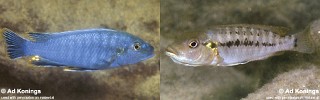
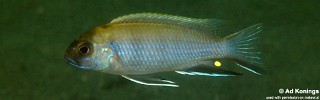
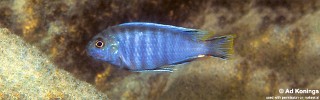
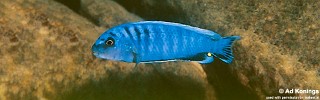
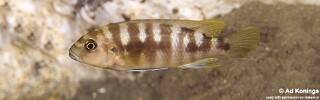
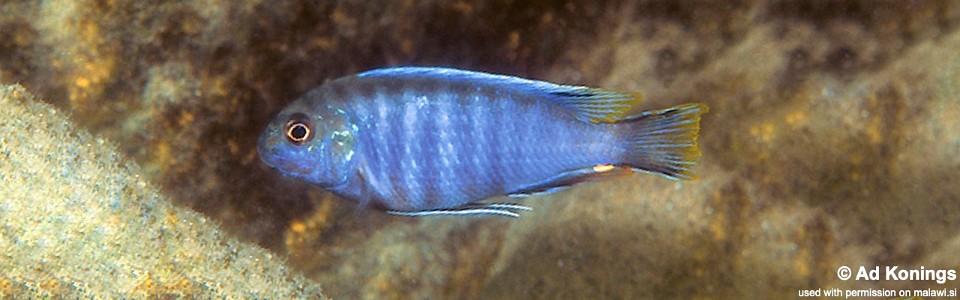




Photo gallery