Pseudotropheus sp. 'aggressive yellow fin' Chizumulu Island
Genus:
Pseudotropheus
Biotope:
Shallow intermediate habitat around Chizumulu Island and surrounding
isalnds, occurring among small and medium-sized rocks in waters less
than 6 m deep.
Geographic distribution:
Only known from around Chizumulu Island, including Machili Island and
Same Bay.
Typical adult size:
Up to about 10 cm total length.
Sexual dimorphism:
Males are larger than females, with longer fins and a vivid blue
coloration; females are dark brown to grey and lack the male’s vivid
blue coloration.
Recommended aquarium size:
An aquarium volume of 500 l or more is recommended.
Diet:
Territorial males feed from the rock surface within their territories and
also take plankton from the water column while remaining close to the
rocks. In captivity it readily accepts varied foods, but feeding should
be rationed and based mainly on vegetable items.
Breeding:
Maternal mouthbrooder. Spawning involves circular movements with a
‘T’-shaped posture; eggs are taken into the female’s mouth and
fertilized. Incubation lasts around 3 weeks.
Aggression:
Among the most aggressive mbuna; both sexes can be territorial and
territory holders are highly intolerant of intrusions. Territories are
often about 50–100 cm in diameter, with smaller territories forming
in slightly overcrowded tanks.
Special notes:
A deep-bodied, cobalt-blue “aggressive” mbuna lacking black markings.
Recognizable by a markedly concave forehead with a prominent snout and
densely set outer-row teeth described as those of an algae puller. The
overall coloration is uniform, with only faint traces of vertical bars
and a slightly more visible cephalic melanin pattern in aggressive
individuals; horizontal stripes are absent. It has been described as a
peculiar form with no apparent close relative, with a body profile
recalling tropheines, and it has been suggested to represent an
ancient lineage within mbuna.
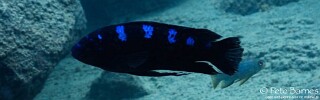
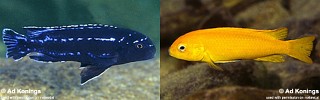
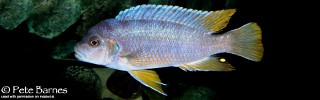
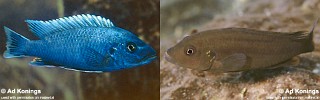
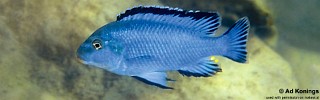
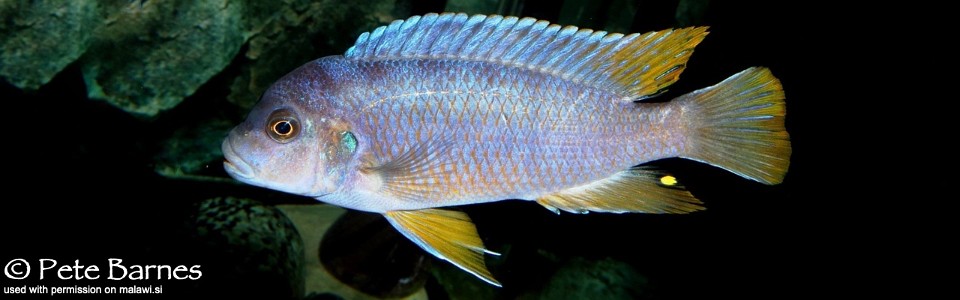




Photo gallery