Strictly associated with rocky habitats; prefers large caves
between boulders and is often recorded at depths greater
than 10 m.
Geographic distribution:
Northern two-thirds of Lake Malawi along both eastern and
western shores; southern limits at Gome (east) and Jalo
Reef near Nkhotakota (west).
Typical adult size:
Males up to about 16 cm total length; females rarely
exceed 12 cm.
Sexual dimorphism:
Males larger and exhibit breeding coloration with yellow/orange
ocelli on the anal fin and a blue/black dorsal fin with a
very narrow white margin and orange/red lappets. Females
lack distinct breeding coloration.
Diet:
Scavenges material from the rocky substrate, including
droppings of other fishes.
Breeding:
Males maintain territories inside large caves and seldom leave
them. Spawning and mouthbrooding females have not been
observed.
Special notes:
Distinguished from Otopharynx lithobates by a larger
number of teeth in the outer row of the left lower jaw
(mode 22 vs. 16), fewer gill rakers (mode 12 vs. 14),
longer lower jaw, and absence of a white/orange blaze on
the head and nape in males. Females of the two species
cannot be distinguished by melanin pattern.
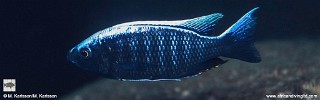
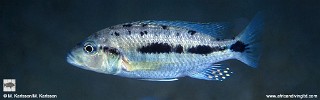
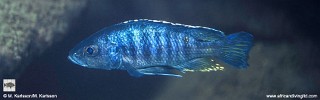
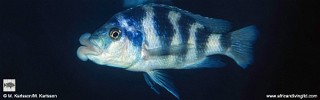
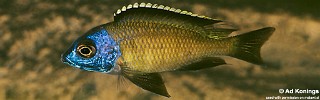
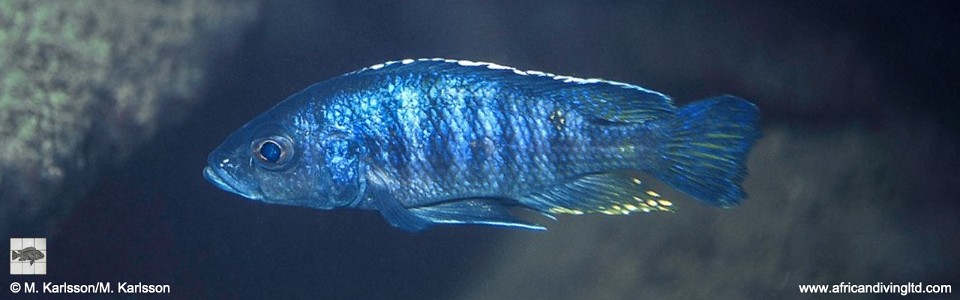




Photo gallery