Deeper rocky and intermediate habitats. Males patrol territories at average depths
of about 10–15 meters along the north-western Malawian shores, and the species is most
common between 5 and 10 meters. In areas with abundant rocks and shelter it may occur
together with other Petrotilapia, while in deeper or more sparsely structured
habitats it is often the dominant representative of the genus.
Geographic distribution:
Occurs along the north-western shores of Lake Malawi, including areas from Hora
Mhango to Kande Island. Type specimens were collected at Nkhata Bay. Populations
previously referred to as P. sp. ‘ruarwe’ are regarded as conspecific, which
considerably extends the known range along the western shoreline.
Typical adult size:
Males reach about 16–17 cm total length, while females are slightly smaller at about
12–15 cm. In aquarium conditions, males have been reported to attain up to about
20 cm total length.
Sexual dimorphism:
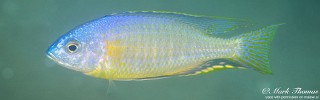
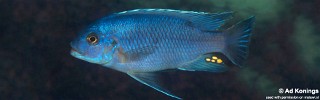
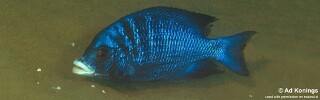
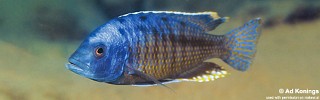
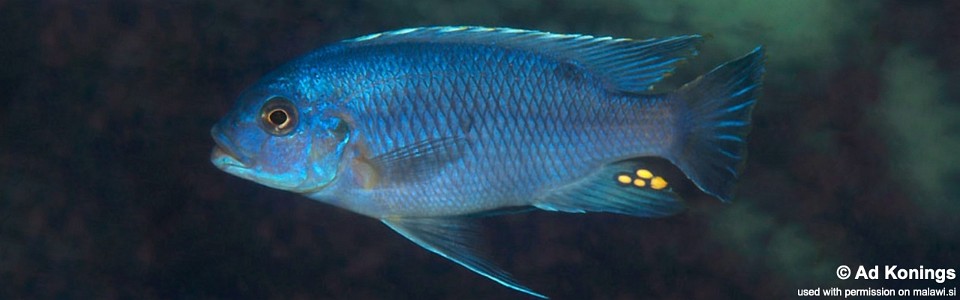
Males display bright blue breeding coloration with 5–7 faint vertical bars and a blue
head; in some populations the belly, breast and ventral fins are yellow, and pelvic
fins may be yellow-orange or blue depending on locality. At Mbowe Island males can be
dark purple-blue with a vivid orange chin and pelvic fins.
Females are bright yellow when young or non-brooding, but may become light beige to
gray-brown, especially when mouthbrooding or older. Juveniles are bright yellow in
several populations.
Recommended aquarium size:
An aquarium volume of 500 L is recommended, with a minimum tank length of about
200 cm advisable.
Aquarium setup:
Males are likely to be permanently territorial and it is strongly recommended not to keep more than one male
in the same aquarium. Provide ample rockwork with caves that offer shelter for
females, including retreats too small for the male to enter.
Diet:
Omnivorous with a strong grazing component. Feeds by scraping algae (aufwuchs),
including diatoms and associated microorganisms, from rock surfaces using multiple rows
of tricuspid teeth. It also consumes plankton and associated microfauna; juveniles feed
primarily from the aufwuchs shortly after release.
Breeding:
Maternal mouthbrooder. Breeding males defend territories approximately four meters
in diameter, usually centred around a cave among rocks. Spawning takes place inside the
male’s cave; females may visit several males for fertilisation.
Incubation lasts about three weeks. Mouthbrooding females remain solitary and hide
among rocks; fry are released at the same depth as the adults live and begin feeding on
aufwuchs almost immediately.
Aggression:
Aggressive within the species, particularly among territorial males. Generally
tolerant toward other species, although males defend breeding territories against
conspecific rivals.
Special notes:
Previously known as P. sp. ‘small blue’ and P. sp. ‘ruarwe’, and
considered part of the informal P. nigra group.
Characterised by a black submarginal band in the dorsal fin, distinguishing it from
certain congeners. Female and juvenile yellow coloration is an important feature in
distinguishing this species from some northern populations of the nigra-type
Petrotilapia.

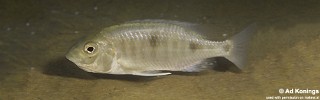



Females are bright yellow when young or non-brooding, but may become light beige to gray-brown, especially when mouthbrooding or older. Juveniles are bright yellow in several populations.
Incubation lasts about three weeks. Mouthbrooding females remain solitary and hide among rocks; fry are released at the same depth as the adults live and begin feeding on aufwuchs almost immediately.
Characterised by a black submarginal band in the dorsal fin, distinguishing it from certain congeners. Female and juvenile yellow coloration is an important feature in distinguishing this species from some northern populations of the nigra-type Petrotilapia.
Photo gallery