Sandy habitats at moderately deep levels, generally deeper
than 15 m.
Geographic distribution:
North-western Lake Malawi, including Mdoka, Chesese and
Chirwa Island. Most aquarium specimens originate
from Mdoka.
Typical adult size:
Wild size not precisely documented; imported males measure
about 12–15 cm TL and may exceed 20 cm TL
in long-term aquarium conditions.
Sexual dimorphism:
Sexual dichromatism is absent. Males grow larger than
females and develop longer fins and a more
pronounced mouth. Older females may lose the
intense blue coloration and appear pale.
Recommended aquarium size:
A minimum aquarium volume of 500 l is recommended for
a group of 5–6 individuals. In mixed tanks with
large sand-foraging species, 800–1000 l is
required.
Aquarium setup:
Provide extensive open sand areas with limited rockwork.
Water should be clean, well filtered and strongly
oxygenated, with a pH around 7.8–8 and a
temperature near 25 °C. The species is sensitive
to poor water quality and benefits from frequent,
moderate feeding rather than large meals.
Diet:
Feeds by hovering above sand and collecting edible
particles, often exploiting sediment disturbed by
large sand-foraging genera such as
Taeniolethrinops and Fossorochromis.
In aquaria it accepts small frozen foods such as
Artemia and Cyclops, supplemented with quality
dry foods.
Breeding:
Maternal mouthbrooder. Males select a sheltered site and
court females with display movements before
spawning. Eggs are collected and incubated in the
female’s mouth for about 3 weeks at 25 °C.
Fry are released gradually once the female
perceives sufficient safety.
Aggression:
Quarrelsome mainly toward conspecific males, but serious
damage is uncommon due to relatively weak bites.
Males engage in frequent mouth contests.
Special notes:
Recognized by its deep blue coloration and distinct white
snout tip. Juveniles show a barred pattern similar
to members of the P. electra group. Evaluated
as Endangered (EN) on the IUCN Red List (2018).
Sexual dichromatism is absent, which is unusual
among haplochromines.
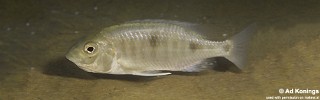
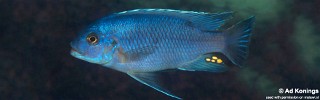
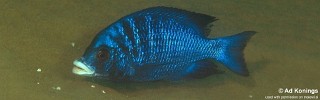
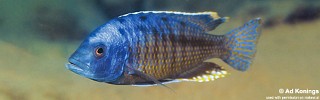
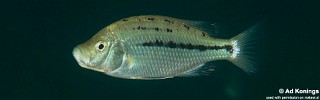
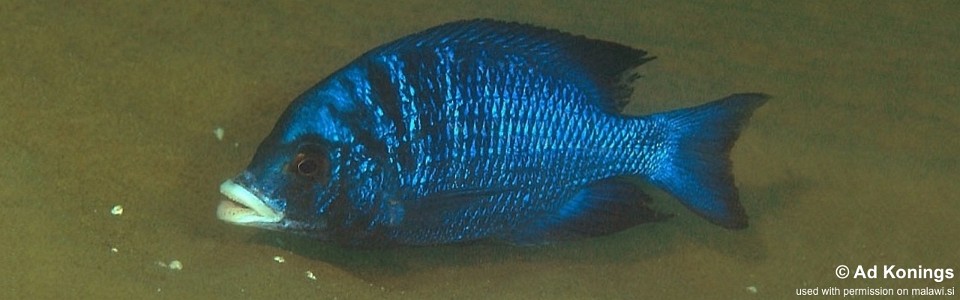




Photo gallery