Shallow rocky and intermediate habitats; most common in shallow
wave-washed rocky areas free of sediment. Rarely recorded deeper
than 5 m.
Geographic distribution:
Known from Chizumulu Island; recorded at Chiwi Rocks, Mkanila Bay,
and Same Bay.
Typical adult size:
Males up to about 17 cm total length; females rarely exceed
about 14 cm. Another reported maximum total length is
15 cm.
Sexual dimorphism:
Males sky-blue with bright orange-red ventral fins; females beige
to chocolate brown with a distinct row of black blotches on the flank.
Both sexes possess a black submarginal band in the dorsal fin.
Recommended aquarium size:
Minimum tank length about 200 cm.
Aquarium setup:
Rocky layout with caves for spawning and retreats, including shelters
too small for the male to enter. Avoid keeping more than one male in the
same aquarium. Select tankmates with different male breeding coloration.
A mouth-brooding female can be separated from the male until fry are
released. Recommended pH 7.0–8.5 and temperature 23–28 °C.
Diet:
Herbivorous aufwuchs grazer; scrapes diatoms and small algae from
rock surfaces using specialized lips and multiple rows of tricuspid
teeth. Feeding activity leaves clearly cleaned substrate patches.
Breeding:
Maternal mouthbrooder. Breeding males defend territories about
5 m in diameter centered on a cave, often with an entrance at the
base near sand. Spawning occurs inside the cave; females may visit
multiple males. Incubation lasts about three weeks, after which fry are
released and immediately begin feeding from aufwuchs.
Aggression:
Breeding males are territorial; females and non-breeding males are
solitary.
Special notes:
Distinguished by a distinct black submarginal band in the spinous
part of the dorsal fin in both sexes. Member of the informal
P. genalutea group characterized by such a band and dark flank
blotches.
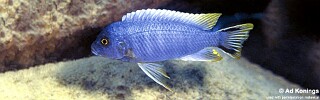
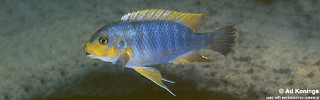
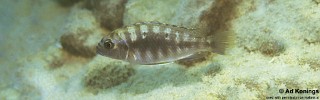
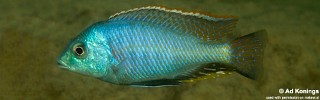
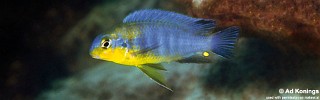
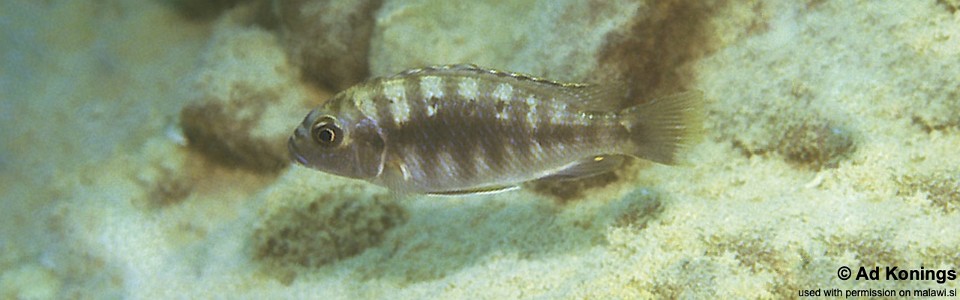




Photo gallery