Open sandy regions; usually recorded at depths between
5–30 m.
Geographic distribution:
Recorded from various localities around Lake Malawi,
including Mdoka, Masinje and Ntekete; may have a lake-wide
distribution.
Typical adult size:
Less than 14 cm total length.
Sexual dimorphism:
Breeding males obscure the characteristic flank blotches
completely with breeding coloration.
Diet:
Feeds on small invertebrates picked individually from the
sand; the small mouth is used to select prey items after
visually inspecting the substrate.
Breeding:
Males gather in breeding colonies and construct sand-castle
bowers spaced 3–5 m apart. Bowers have a base diameter
of about 60 cm and a height of approximately 10 cm.
Special notes:
Characterized by a diagonal row of three double blotches
on the flank; in some specimens the blotches merge into
a broad dark band. Most individuals forage alone.
Individuals from the east coast population show yellow
coloration on body and fins, whereas specimens from
other localities are more silvery with colorless fins.
Previously referred to as Mylochromis sp. ‘double spot’;
later determined to be conspecific with Otopharynx decorus.

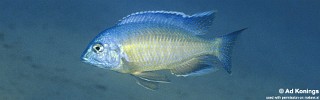
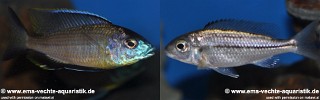
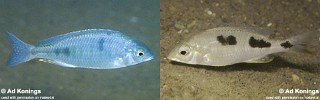
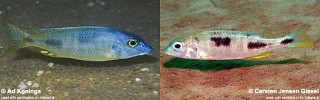
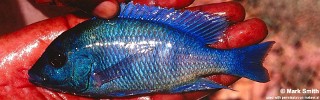
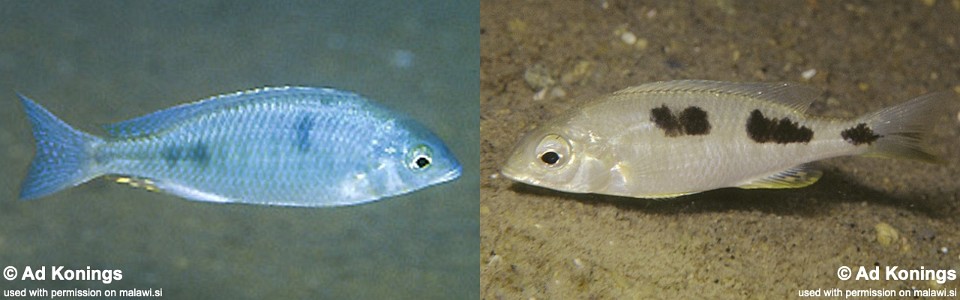



Photo gallery