Rocky habitats among large and medium-sized rocks, including large caves.
Reported from about 7 m to at least 40 m depth and often observed
clinging to rock surfaces, including in an upside-down position. The species is
described as being encountered in low numbers; males are weakly territorial and
females are described as non-territorial in the wild.
Geographic distribution:
Reported from Mumbo Island and Otter Island in the southern part of Lake
Malawi.
Typical adult size:
Wild males are reported to reach about 8.5–9 cm total length, while females
remain about 25% smaller. Aquarium-kept specimens are reported to reach up to
about 12 cm.
Sexual dimorphism:
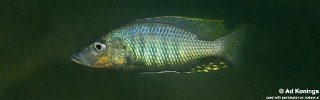
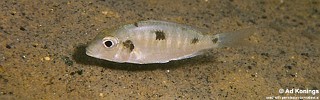
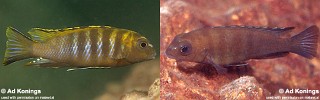
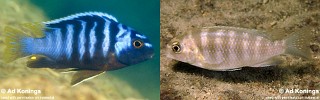
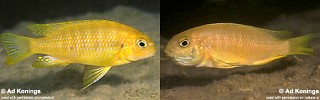
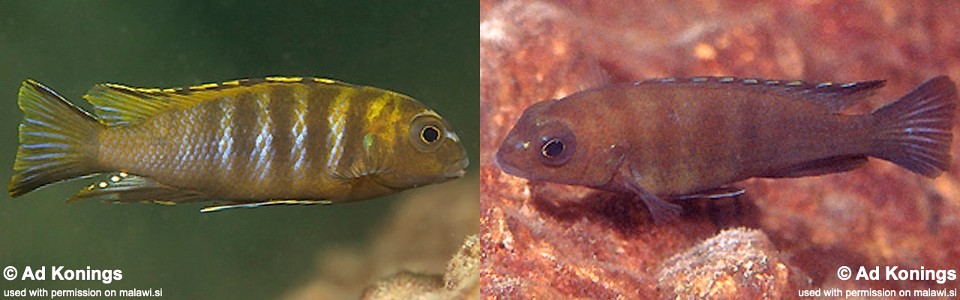
Territorial males are described as greenish-blue with a green-yellow nape and
upper flank and 5–6 distinct brown bars. Females are described as light to dark
brown with 4–5 faint lateral dark brown bars.
Recommended aquarium size:
A minimum tank length of 120 cm is recommended for a species-only setup,
and an aquarium volume of about 300 L is recommended.
When kept with other mbuna, an aquarium volume of at least 400 L with a
minimum tank length of 150 cm is recommended.
Aquarium setup:
Arrange extensive rockwork with many hiding places such as crevices, caves, and
shaded areas; rock structures may extend close to the water surface. It is
recommended to avoid tankmates that resemble the male breeding coloration, because
males are described as responding more aggressively to lookalikes and females may
mistake males of a similar species as mates, leading to hybrids.
Diet:
An aufwuchs grazer that feeds by picking and tearing algal matrix from rock
surfaces, including cyanobacteria and associated algae. It is also reported to
feed on plankton when available; aquarium feeding notes include the option of
offering small portions of frozen foods at intervals alongside an algae-based
diet.
Breeding:
A maternal mouthbrooder. Spawning is suggested to take place in the darker
recesses of the rocky habitat, probably inside large caves. Mouthbrooding is
described as lasting about 3 weeks, and females are described as rarely seen
while brooding; it is further suggested that fry are released at the free-swimming
stage and then abandoned.
Aggression:
In the wild, males are described as only weakly territorial and females as
non-territorial. In the aquarium, adult males are described as likely to become
persistently territorial, with increased aggression reported toward lookalike
males.
Special notes:
Before its formal description, the species was known as Tropheops sp.
‘greenback’, a name coined for the Otter Island population. It is described as an
elongate type that often clings to rock surfaces in an upside-down position,
particularly in large caves.




When kept with other mbuna, an aquarium volume of at least 400 L with a minimum tank length of 150 cm is recommended.
Photo gallery