Intermediate habitat, mainly at the rock–sand interface,
but also occurring in purely rocky areas. Recorded from
depths of 3–18 m, with most individuals found in
shallow water.
Geographic distribution:
Occurs along the eastern shore of Lake Malawi from
Chuanga in Mozambique to Cape Ngombo (Makanjila Point).
Northern populations (Chuanga and Metangula) may lack
the light-blue horizontal stripes in males.
Typical adult size:
Reported maximum size is about 11 cm in males and
9 cm in females. In aquarium conditions both sexes
may grow several centimeters larger.
Sexual dimorphism:
Sexual dichromatism is pronounced. Males are dark
blue-black with two light-blue longitudinal bands,
while females are entirely yellow to yellow-orange.
Mouth-brooding females may temporarily show elements
of the male pattern.
Recommended aquarium size:
An aquarium volume of 300 L is recommended.
Aquarium setup:
Provide abundant rockwork with numerous hiding places.
Open areas between rocks should allow free movement.
One male should be kept with at least 3–4 females,
though larger groups such as 3 males with 9 females
are possible. Suitable tankmates are robust,
algae-grazing mbuna that also consume
microorganisms.
Diet:
Omnivorous. Feeds primarily from aufwuchs,
consuming algae, zooplankton and small
invertebrates. Individuals may also feed on
plankton in the water column.
Breeding:
Maternal mouth-brooder. Spawning takes place between
rocks. Females brood 10–30 eggs for about 20 days
and do not feed during incubation. After release,
fry are not taken back into the mouth and may
form groups with similarly sized juveniles.
Aggression:
Highly aggressive within the species, particularly
among males. Generally tolerant toward other species,
especially when maintained in larger groups.
Special notes:
Member of a closely related group including
P. interruptus, P. perileucos and
P. cyaneorhabdos. Males are almost
indistinguishable from those of
P. cyaneorhabdos. Historically placed in
Melanochromis due to superficial resemblance,
but later reassigned to Pseudotropheus.


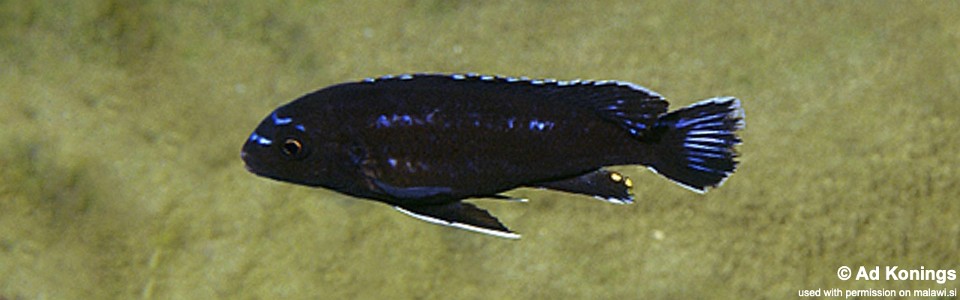




Photo gallery